Red Banana (Sevvazhai): What It Really Offers, and Which Popular Claims Don't Hold Up
Red banana is a much-loved fruit in Tamil homes, and it is often described as a remedy for everything from kidney stones to loose teeth. It is a good, nourishing fruit. But some of the claims go well beyond what the evidence shows, and for one group of people bananas need real caution. Here is what holds up.
- 1 medium red banana358 mg
- 2 red bananas716 mg
- WHO daily recommendation (adult)3,510 mg
In this guide
Quick answer
- Good fruit, not medicine: red banana gives energy, fibre, potassium and vitamin B6, much like a yellow banana. It has more polyphenols and red pigments, but reliable red-banana-specific nutrient data is limited.
- Kidney stones: diets higher in potassium are linked to lower stone risk in large studies. One fruit alone won't prevent stones; water and less salt matter more.
- Kidney disease: bananas are high in potassium. If you have kidney disease or are on dialysis, ask your doctor first.
- Night blindness, loose teeth, "nerve weakness": no evidence that red banana cures these. See an eye doctor, a dentist or a physician.
- Diabetes: fine in portions; one small banana with a meal.
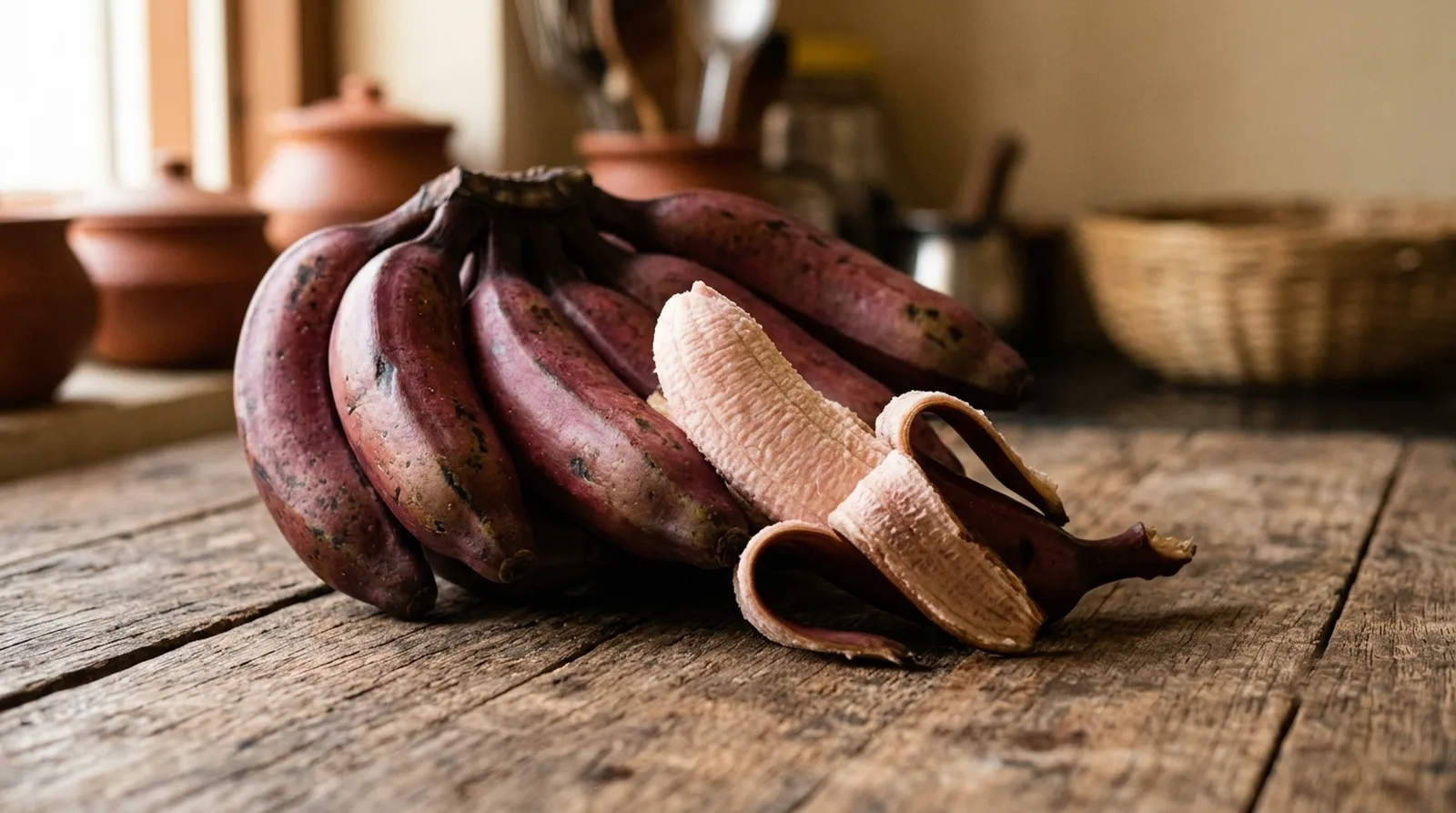
Red banana, called sevvazhai in Tamil and chenkadali in Malayalam, is a variety of the same species as the common yellow banana. It has reddish-purple skin, cream-to-pink flesh and a sweeter, slightly berry-like taste. It is a nourishing fruit. Below, each popular claim is checked against nutrition data and published research.
What is in a red banana
Separate, reliable nutrient tables for red banana are limited, so the figures below use standard data for raw banana, which is broadly similar.
| Per 100 g of fruit (about one medium banana) | Approximate amount |
|---|---|
| Energy | about 89 kcal |
| Carbohydrate | about 23 g |
| Fibre | about 2.6 g |
| Potassium | about 358 mg |
| Vitamin B6 | about a fifth of a day's need |
| Vitamin C | about a tenth of a day's need |
Where red bananas differ: studies have found red bananas carry somewhat more polyphenols (plant antioxidants) and contain anthocyanins, the red-purple pigments that yellow bananas lack. They are also often described as richer in carotenoids such as beta-carotene, though good measurements are scarce. These are real but modest differences; red banana is not in a different league from yellow banana.
Vitamin C: a banana gives some, but it is not a rich source. For comparison, a single fresh amla gives many times more; see our amla juice guide.
Kidney stones: what the evidence says
The claim has a real basis, but it is about the whole diet, not one fruit:
- Three large long-term studies of nearly 1.94 lakh adults in the United States, published in 2016, found that people with higher potassium intake had a lower risk of developing kidney stones in all three groups. Higher potassium intake was also linked to more citrate in the urine, which helps prevent stones.
- Potassium comes from fruit, vegetables, pulses and dairy. One banana gives about 10% of the WHO's recommended daily potassium for adults, as the chart above shows.
- The biggest stone-prevention steps remain: drink enough water, cut down on salt, and eat plenty of fruit and vegetables overall. People who have had stones should follow their doctor's advice, which depends on the type of stone.
The important caution: kidney disease
For people with chronic kidney disease, especially at later stages or on dialysis, the kidneys may not clear potassium well. High blood potassium can disturb the heartbeat. Kidney diet guides list bananas among high-potassium foods to limit.
The same caution applies to people taking medicines that raise potassium, which can include some blood pressure and heart medicines. If this is you, ask your doctor or dietitian before eating bananas regularly.
Claims that are not supported
"Cures night blindness." Night blindness can be an early sign of vitamin A deficiency, and foods with vitamin A and beta-carotene help prevent that deficiency. But no fruit is a proven treatment, beta-carotene corrects deficiency less effectively than vitamin A itself, and night blindness also has other causes, including cataract and inherited retinal conditions. Anyone who struggles to see in dim light should see an eye doctor.
"Eat it for 21 days and a loose tooth becomes firm." There is no evidence for this. A loose adult tooth is most often caused by gum disease, injury or teeth grinding. Dentists say there is no home method that tightens a loose tooth; early professional cleaning below the gum line can sometimes save it, and delay can mean losing it. See a dentist promptly.
"Cures nerve weakness" (narambu thalarchi). This is a broad, everyday term, not a specific diagnosis. A banana gives quick energy and vitamin B6, and feeling stronger after a meal is real. But lasting weakness, tiredness, tingling or numbness can come from anaemia, vitamin B12 deficiency, thyroid problems or diabetes, which need tests and treatment.
Types, and choosing a good one
Red banana is grown mainly in Tamil Nadu, Kerala, Karnataka and Andhra Pradesh and goes by several names, including sevvazhai, chenkadali and lal kela. The standard red banana has purplish-red skin and orange-to-yellow flesh with a pleasant aroma. Shops may sell red-skinned fruit from different areas and growers, and the shade of red, size and taste can differ with the variety, the soil and how ripe it is. We found no reliable evidence that one regional type is nutritionally better than another.
Ripening: FSSAI prohibits calcium carbide for ripening fruit; ripening with ethylene gas under its guidelines is allowed. There is no fully reliable way to spot carbide-ripened fruit by eye, so buy from sellers you trust, wash the fruit, and avoid fruit that smells of chemicals or is ripe outside but hard and raw inside.
Diabetes: how to eat it
- A medium banana has roughly 25–30 g of carbohydrate. Its glycemic index is low to medium, about 31 to 62, rising as the fruit ripens.
- Eat one small banana at a time, not several together, and count it in your meal's carbohydrate.
- Prefer a just-ripe fruit over a very soft, overripe one.
- Have it with curd, nuts or a meal rather than alone on an empty stomach; protein and fat slow the rise in sugar.
- Check your sugar after eating it a few times to see how your body responds, and follow your doctor's or dietitian's plan.
Price: is red banana worth paying more for?
Red banana often costs more than common varieties. Nutritionally, the gap is small: a yellow or local banana such as poovan, rasthali or karpooravalli gives similar energy, fibre, potassium and vitamin B6. Buy red banana if you enjoy its taste; if it is too costly, a common banana plus a variety of other fruit and vegetables serves your health just as well.
A sensible way to eat it
- One or two a day fits well in most healthy adults' diets.
- Choose ripe fruit: the skin turns deep red-purple and gives slightly when pressed.
- Diabetes: one small banana, ideally with a meal or with curd or nuts, rather than several at once.
- Kidney disease, dialysis or potassium-raising medicines: ask your doctor first.
- Don't rely on it for stones, eyes, teeth or weakness; get the cause checked.
Final word
Red banana is a tasty, nourishing fruit with a little more antioxidant colour than yellow banana. A diet rich in potassium from fruit and vegetables is linked to fewer kidney stones, and a banana helps with that. But it does not cure night blindness, tighten loose teeth or treat nerve problems, and people with kidney disease need to limit it. Enjoy it as food; take symptoms to a doctor.
This article is general health information, not medical advice. It does not replace consultation with a doctor, dentist or dietitian. Nutrient values vary with variety, size and ripeness.
References
- Ferraro and others, Clinical Journal of the American Society of Nephrology (2016): Dietary protein and potassium and risk of kidney stones
- Academy of Nutrition and Dietetics (eatright.org): Kidney disease, high- and moderate-potassium foods
- Nutrition Advance: Red bananas, nutrition and research
- Wikipedia: Red banana
- PeaceHealth: Night blindness and vitamin A
- Dentaly: Loose adult tooth, causes and treatment
- ICAR National Research Centre for Banana: Red Banana cultivar
- FoodTechBiz: FSSAI directs states to curb illegal fruit ripening (2025)
- Healthline: Bananas and diabetes
How we made this guide
- Facts checked against 9 sources, listed at the end of the guide.
- Worked examples and calculations are our own, with the assumptions stated in the guide.
- Last updated November 5, 2026. We revise guides when rules and prices change.
Frequently asked questions
Is red banana more nutritious than yellow banana?
Broadly they are similar: both give carbohydrate, fibre, potassium and vitamin B6. Studies have found more polyphenols and some pigments (anthocyanins) in red bananas, and they are often described as richer in carotenoids. But reliable, separate nutrient tables for red banana are limited, and the differences are modest. Eat whichever you enjoy.
Does red banana prevent kidney stones?
Not on its own. Large long-term studies of nearly 2 lakh adults found that people with higher potassium intake from their overall diet had a lower risk of kidney stones. A banana contributes potassium, but drinking enough water, limiting salt and eating plenty of fruit and vegetables overall matter more than any single fruit.
Can people with kidney disease eat red banana?
Be careful. In chronic kidney disease, the kidneys may not remove potassium well, and too much can affect the heart. Bananas are listed among high-potassium foods. If you have kidney disease, are on dialysis, or take medicines that raise potassium, ask your doctor or dietitian how much, if any, you can eat.
Can red banana cure night blindness?
No single fruit cures it. Night blindness can be an early sign of vitamin A deficiency, but it also has other causes such as cataract and inherited retinal conditions. A diet with vitamin A and beta-carotene foods helps prevent deficiency; anyone with difficulty seeing in the dark should see an eye doctor.
Will eating red banana for 21 days tighten a loose tooth?
There is no evidence for this. A loose adult tooth is most often caused by gum disease, injury or teeth grinding, and it needs a dentist. Early treatment such as cleaning below the gums can sometimes save the tooth; waiting can lead to losing it.
Is red banana good for diabetes?
People with diabetes can usually eat a banana as part of their meal plan, but it is a carbohydrate-rich fruit, so portion matters. One small banana at a time, with a meal rather than alone, is a common approach. Check with your doctor or dietitian for your own plan.
If not red banana, what should I eat for tiredness or weakness?
First find the cause: a simple blood test can check for anaemia, vitamin B12 deficiency, thyroid problems and diabetes, which are common reasons for lasting tiredness. Alongside that, a balanced diet helps: iron from greens, dal and millets; vitamin B12 from milk, curd, eggs, fish or meat; enough protein; and regular sleep.