Red Brick vs AAC Block vs Interlock Brick: Which Saves More Money When Building a House?
Comparing only the price of one brick and one block gives the wrong answer. The real cost includes mortar, plaster, curing water, labour, and for multi-storey buildings, the steel and concrete needed to carry the walls. Here is how red bricks, AAC blocks and interlock bricks really compare.
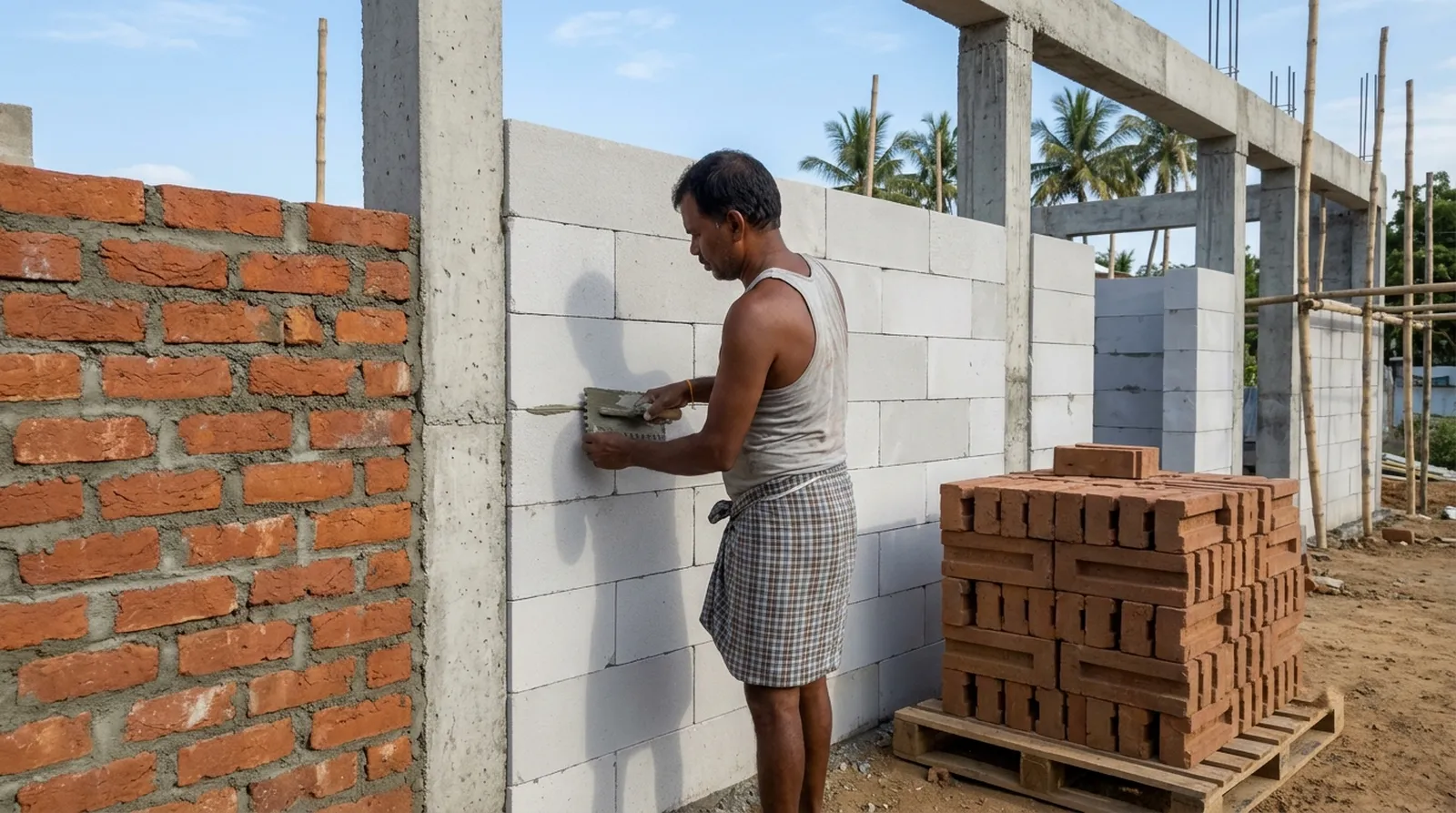
- Red clay brick (9 inch)3,950 kg
- Fly ash brick (9 inch)3,600 kg
- AAC block (8 inch)1,300 kg
In this guide
Quick answer
- Single-storey or load-bearing house, with good local bricks: red brick is usually the simplest and safest choice.
- RCC-framed house of two floors or more: AAC blocks usually work out better, thanks to lighter walls, less mortar and plaster, faster work and cooler rooms.
- Interlock bricks: can save mortar and labour on low-rise homes, but need precise work and good weather protection.
- Decide on the total cost, not the price of one brick: mortar, plaster, curing water, labour, transport and the structure all count.
Ask a contractor and you'll hear "bricks are best" or "AAC is the future". Both can be right. The best wall material depends on how many floors you're building, how the structure is designed and what's available near you.
Red clay bricks
Bricks have built most Indian homes for generations, and good, well-burnt bricks still make strong, long-lasting walls.
Hidden costs to count:
- More mortar: bricks vary in size, so joints are thicker and use more cement and sand.
- Thicker plaster: an uneven wall needs more plaster to make it flat.
- Curing water and time: bricks must be soaked before laying, and walls need regular curing.
- Weight: a 9-inch brick wall is heavy. The structure has to carry it.
- Quality varies: under-burnt bricks absorb water, crumble and grow salt patches. Check them: a good brick gives a clear ringing sound when two are struck, and has even colour and sharp edges.
Price example (Madurai, October 2026): about ₹9–12 per brick.
AAC blocks
Autoclaved Aerated Concrete (AAC) blocks are made from fly ash or sand, cement and lime, with tiny air bubbles that make them very light. A common size is 600 × 200 mm, in thicknesses from 75 to 300 mm.
Why builders choose them:
- About one-third the weight of a brick wall, as the chart above shows. Dry density is around 450–650 kg per cubic metre, against about 1,600–1,700 kg for clay bricks.
- Less mortar: blocks are accurate to about ±1.5 mm, so they're laid with a thin layer of block-jointing adhesive instead of thick cement mortar.
- Thinner plaster on the flat wall, and much less curing water.
- Faster work: one block replaces many bricks.
- Cooler rooms: thermal conductivity is about 0.16–0.24 W/m·K, several times lower than brick, so less heat passes through sun-facing walls. Over the years that means less AC use.
What to watch:
- Use the right adhesive, not ordinary cement mortar.
- Cracks at joints: fix mesh where block walls meet RCC beams and columns, and let walls dry before plastering.
- Don't soak the blocks. Keep them dry and covered at site.
- Fixings: heavy items such as TV mounts, kitchen cabinets and water heaters need suitable anchors.
- Not below plinth level: AAC isn't meant for foundations or walls in contact with the ground.
- Masons need to know the method. Brick habits applied to AAC cause most problems.
Price example (Madurai, October 2026): an 8-inch (600 × 200 × 200 mm) block costs about ₹69–105, and 6-inch blocks about ₹40–88 depending on brand.
Interlock bricks
Interlocking bricks have grooves and projections that lock together like Lego, so most of the wall is laid dry, with little or no mortar. Many are compressed stabilised earth blocks (CSEB), made from soil with a small amount of cement, sometimes pressed near the site. Others are made of cement and fly ash.
Advantages: less mortar, neat exposed-brick look, fast laying by a trained team, and low material cost if suitable soil is available nearby.
Practical problems:
- Not 100% cement-free: corners, wall ends, lintels and ring beams still need concrete and steel, often grouted through holes in the blocks.
- The foundation must be perfectly level. Any error shows up in every course above.
- Trained masons are hard to find in many places.
- Weather protection: exposed outer faces need a water-repellent coating or plaster in heavy-rain areas.
- Best for low-rise: mainly single-storey and two-storey load-bearing homes.
Cost: look at the whole wall, not one brick
A rough materials-only example for 100 sq ft of wall at Madurai prices:
| Wall | Units needed | Approx. material cost |
|---|---|---|
| 9-inch red brick wall | about 960 bricks + cement mortar | about ₹10,600 for bricks, plus mortar |
| 8-inch AAC wall | about 77 blocks + jointing adhesive | about ₹6,700 for blocks, plus adhesive |
Then add the differences that don't show in the unit price:
- Mortar and plaster: lower with AAC and interlock bricks.
- Labour: faster with AAC; interlock needs skilled masons.
- Curing water: much lower with AAC.
- Transport: AAC is light per wall area, but blocks break if handled roughly.
- Structure: in RCC-framed buildings of two floors or more, lighter walls can reduce the size and steel of beams, columns and footings.
That last point is where large savings, sometimes quoted as ₹1 lakh or more, come from. It only happens if your structural engineer designs the building for AAC loads from the start. If the structure is designed for brick and you only change the wall material, you get the other benefits but not the steel saving. For a single-storey house, the structural saving is small.
Which should you choose?
| Your situation | Better choice | Why |
|---|---|---|
| Single-storey, load-bearing house | Red brick (or good fly ash brick) | Simple, strong, every mason knows it |
| RCC frame, two floors or more | AAC block | Lighter structure, less mortar and plaster, faster |
| Very hot area, west-facing walls | AAC block | Much better heat insulation |
| Good cheap bricks available locally | Red brick | Low transport cost, familiar work |
| Low-rise home with trained interlock team | Interlock brick | Less mortar, quick build, exposed finish |
| Wet ground or below plinth | Brick or solid concrete block | AAC isn't meant for ground contact |
For costs and stages in a full house, see the 1,000 sq ft house construction cost guide, and before you sign, ask your builder these 10 questions, including which wall material and brand they will use.
Final word
There's no single best wall material. Red bricks remain a sound, simple choice for single-storey and load-bearing homes, especially where good bricks are cheap. AAC blocks shine in RCC-framed, multi-storey buildings and hot climates, as long as they're laid with adhesive and detailed against cracks. Interlock bricks can save mortar on low-rise homes with a skilled team. Compare the total cost of the finished wall and structure, and ask your engineer to design for the material you choose.
Prices are approximate Madurai dealer ranges from October 2026 and vary by brand, quantity and delivery. Weights and quantities are rounded estimates. Always follow your structural engineer's design for wall material and grade.
How we made this guide
- Facts checked against 3 sources, listed at the end of the guide.
- Worked examples and calculations are our own, with the assumptions stated in the guide.
- Last updated November 2, 2026. We revise guides when rules and prices change.
Frequently asked questions
Is AAC block cheaper than red brick?
Per square foot of wall, AAC blocks often cost about the same or a little less in materials, and they need less mortar, thinner plaster and less curing water. The bigger saving comes in multi-storey buildings, where lighter walls can reduce the steel and concrete in beams, columns and foundations, if the structural engineer designs for AAC from the start.
How much lighter is an AAC block wall?
AAC has a dry density of about 450–650 kg per cubic metre, against about 1,600–1,700 kg for clay bricks. In practice, an AAC wall weighs roughly one-third as much as a brick wall of similar size.
Can AAC blocks be used for a load-bearing house?
AAC is mostly used as infill in RCC-framed buildings. Higher-strength grades can be used in some low-rise load-bearing designs, but only if a structural engineer specifies the grade and details. For a simple load-bearing single-storey house, good bricks are usually the safer and simpler choice.
Do AAC block walls crack?
They can, mainly at joints with RCC beams and columns, or when ordinary cement mortar is used, the blocks are laid wet, or plaster is applied too thick. Using block-jointing adhesive, fixing mesh over joints with concrete and letting walls dry before plastering prevents most cracks.
Are interlocking bricks good for houses?
They can work well for single-storey and low-rise homes, especially compressed stabilised earth blocks made near the site. But they still need concrete and steel at corners, lintels and ties, a very level foundation, trained masons and good weather protection on outside faces.
Which is better for heat: brick or AAC?
AAC insulates much better. Its thermal conductivity is about 0.16–0.24 W/m·K, several times lower than clay brick, so less heat passes through walls exposed to the afternoon sun and rooms stay cooler.