Can You Build a House for ₹5 Lakh? A Realistic Budget and Plan
Yes, but only a small one, and only outside big cities. Here is what ₹5 lakh really buys, how the money splits across each stage, and the one place you must never cut corners.
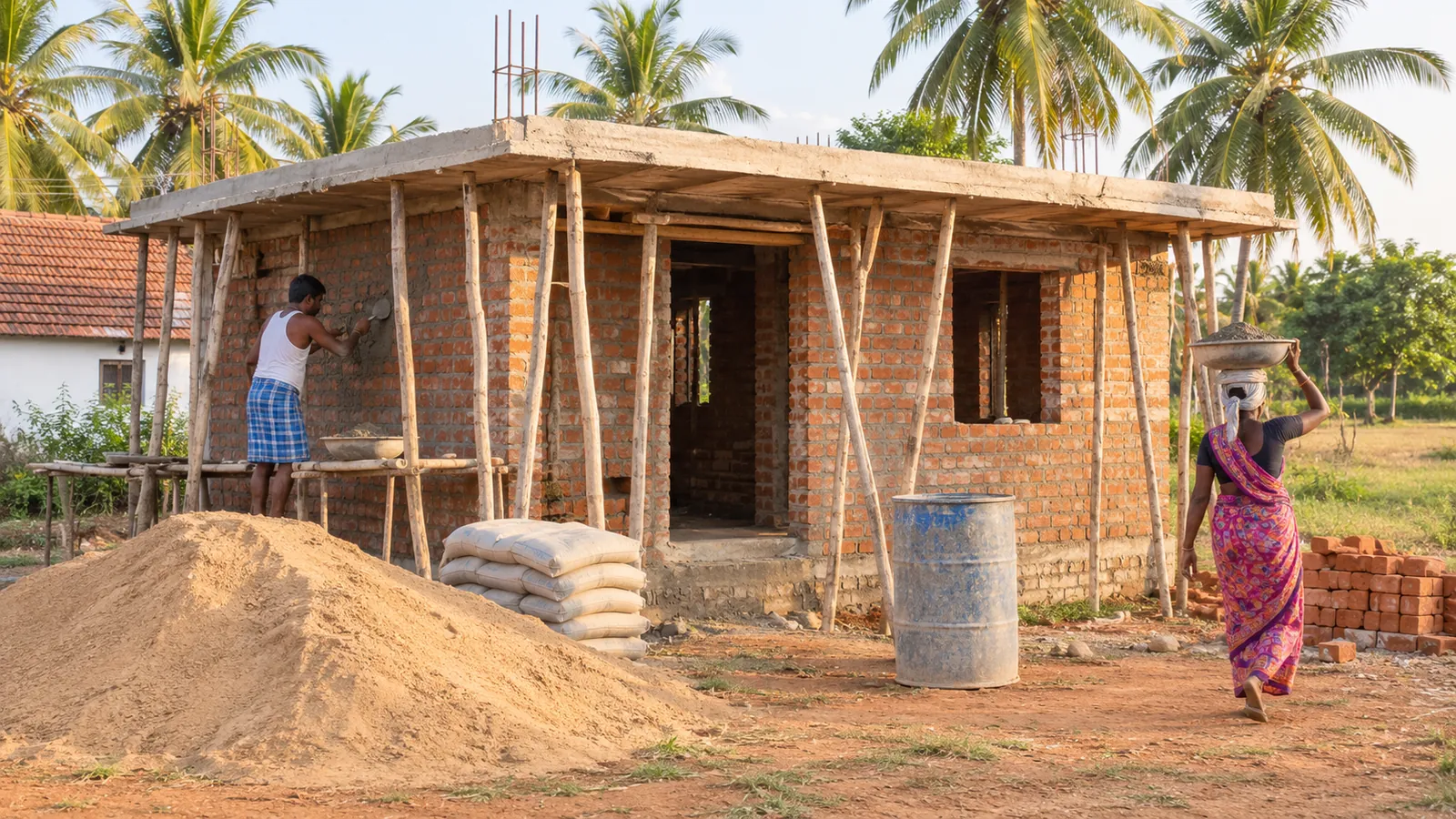
- Foundation, basement₹1,00,000
- Walls₹1,00,000
- Roof concrete₹1,00,000
- Flooring, paint, kitchen₹80,000
- Doors, windows, plumbing, wiring₹70,000
- Buffer for surprises₹50,000
Total₹5,00,000
In this guide
Quick answer
Yes, ₹5 lakh can build a house, but a small one: about 250 to 350 sq ft with a hall, one bedroom, a kitchen and a bathroom. It works in villages and small towns, not in big cities. Plan the five stages to cost about ₹4.5 lakh and keep at least ₹50,000 aside for surprises.
Many people dream of a 1,000 sq ft house on a ₹5 lakh budget. That is not realistic. But a small, solid, livable home is, if you plan it carefully and spend money in the right places.
What ₹5 lakh can really build
- Size: about 250 to 350 sq ft.
- Layout: a small hall, one bedroom, a kitchen and a bathroom.
- Location matters: in villages and small towns, labour and transport cost less. In Chennai or Coimbatore, the same budget is very hard to stretch to a full house.
As a check, basic construction in a city like Madurai is estimated at around ₹1,000 to ₹1,500 per sq ft. At ₹1,500 per sq ft, 300 sq ft comes to ₹4.5 lakh, which leaves just enough for a buffer.
Where the money goes, stage by stage
| Stage | Approximate cost |
|---|---|
| Foundation and basement | ₹70,000–₹1,00,000 |
| Walls (bricks, cement, labour) | ₹80,000–₹1,00,000 |
| Roof concrete | ₹70,000–₹1,00,000 |
| Doors, windows, plumbing and electrical wiring | ₹50,000–₹70,000 |
| Flooring, painting and kitchen platform | ₹60,000–₹80,000 |
| Buffer for transport, lorry hire and surprises | At least ₹50,000 |
The buffer is not optional. Lorry hire, transport, price increases and small mistakes always add up during construction.
Usually not included: the land itself, plan approval fees, and electricity and water connections. Find out these costs locally before you start.
Never compromise here
Never save money on the foundation, the steel rods or the cement. These hold the house up. A weak foundation is a risk to your family's lives, not just a repair bill.
- Use good-quality cement and steel from a known dealer, with a bill.
- Follow the engineer's design for foundation depth and steel size.
- Cure concrete and walls with water for the full recommended period.
- Don't let a contractor reduce the steel to cut cost.
Spend less on tiles, fancy elevations and fittings instead. You can upgrade those later; you can't fix a weak foundation.
Where you can save money
- Keep the shape simple. A square or rectangular box design is the cheapest to build. Arches and curves take more labour time and money.
- Use fewer walls. An open kitchen joined to the hall saves bricks and cement and makes a small house feel larger.
- Build what you need first. Like a basic version of an app, build a simple, livable house now and add features later as money allows.
- Ask about low-cost methods. Techniques such as rat-trap bond walls and filler slab roofs can use fewer bricks and less concrete. Use them only with an engineer or mason who has built with them before.
- Buy materials yourself. Comparing prices from two or three dealers and buying directly can save money, but keep every bill.
Government help you may qualify for
| Scheme | Who it is for | Help per house |
|---|---|---|
| PMAY-Gramin | Eligible rural households | ₹1.20 lakh in the plains |
| Kalaignar Kanavu Illam (Tamil Nadu) | Eligible rural hut-dwelling households | ₹3.5 lakh; minimum 360 sq ft with a concrete roof |
| PMAY-Urban 2.0 (Beneficiary Led Construction) | Urban families with annual income up to ₹3 lakh, building on their own land | Up to ₹2.5 lakh |
Eligibility rules and selection processes apply; ask your panchayat office, municipality or block development office. Combined with your own savings, these schemes can make a ₹5 lakh house far more achievable.
Protect your family's safety net
Don't turn your entire life savings into a house. Before construction starts, set aside an emergency fund for medical needs and other surprises. A half-built house with no money left is worse than a smaller house finished on time.
Final word
A ₹5 lakh house is possible: about 300 sq ft, built in a village or small town, with a simple shape and an open layout. Spend properly on the foundation, steel and cement, keep a ₹50,000 buffer, and check whether a government housing scheme can add to your budget. Build the basics now and improve the house later.
Costs are approximate and vary by location, material prices and design. Get a local engineer's estimate and the required approvals before you start building.
Frequently asked questions
How big a house can I build for ₹5 lakh?
About 250 to 350 sq ft: a small hall, one bedroom, a kitchen and a bathroom. A 1,000 sq ft house is not possible on this budget.
Can I build a ₹5 lakh house in Chennai or Coimbatore?
It is very difficult. Labour, transport and material costs are higher in big cities. The budget is realistic mainly in villages and small towns.
What is the construction cost per sq ft in Tamil Nadu?
For basic construction in a city like Madurai, estimates run around ₹1,000 to ₹1,500 per sq ft, and ₹1,300 to ₹2,000 for standard quality. Rates are higher in metros and change with material prices.
Where should I not compromise to save money?
The foundation, the steel rods and the cement. A weak foundation or poor steel puts lives at risk. Save on tiles, finishes and design instead.
Is there government help to build a house?
Rural households may qualify for PMAY-Gramin (₹1.20 lakh in the plains) or, in Tamil Nadu, Kalaignar Kanavu Illam (₹3.5 lakh per house for eligible hut dwellers). Urban low-income families may get up to ₹2.5 lakh under PMAY-Urban 2.0. Eligibility rules apply.
Should I spend all my savings on building the house?
No. Keep an emergency fund for your family aside before you start. Build a basic house first and improve it later as money allows.