Building on a 1 Cent Plot: How to Plan a Small House That Feels Big
A 1 cent plot looks small on paper and smaller after the setback rules. Planned well, it can still hold a comfortable home. Here is how much you can really build, how to lay it out, and where to save without weakening the house.
In this guide
Quick answer
- 1 cent = 435.6 sq ft, roughly a 20 ft × 22 ft plot.
- After setbacks, you can build about 250 to 350 sq ft on the ground floor.
- A single-storey home of that size can cost around ₹6 lakh to build in a town or village, not counting land, approvals and connections.
- The keys to a good small house: no corridors, an open hall and kitchen, and kitchen and bathroom back to back.
A small plot forces hard choices. The good news is that most of the space in an ordinary house is lost to corridors, extra walls and awkward corners. Remove those, and 300 sq ft can feel like much more.
If your main question is the total budget, see our guide on building a house for ₹5 lakh. This guide focuses on planning and building on a small plot.
How much you can really build
Building rules require open space (setbacks) between your house and the road, and usually on one side. On a 1 cent plot, that space comes out of a very small area.
| Item | Example |
|---|---|
| Plot (1 cent) | 435.6 sq ft (about 20 × 22 ft) |
| Front setback for a road up to 9 m wide | about 1.5 m (5 ft) |
| Side setback (one side) | about 1 to 1.5 m |
| Built-up area on the ground floor | about 250 to 350 sq ft |
Small-plot setback rules are detailed and change from time to time. Confirm the exact figures for your plot with a licensed engineer or your local body before you finalise the plan.
Plan the layout like a puzzle
Think of the plot as a puzzle where every square foot must have a use.
- No long corridors. A corridor is floor area you pay for but can't live in. Let rooms open directly from the hall.
- Open hall and kitchen. Skipping the wall between them makes both feel larger, lets light travel further and saves bricks and cement.
- Kitchen and bathroom back to back. When both share one wall, water and drain pipes stay short. That cuts plumbing cost and future leak points.
- Built-in storage. Use wall niches and lofts over doors instead of bulky furniture.
- Light and air. Place windows on opposite walls where possible, so a small house stays cool and bright.
Where to save in construction
Load-bearing walls instead of a column frame
In a load-bearing house, the walls themselves carry the roof, so you don't need a full frame of concrete columns and beams. For a small single-storey home, this can save a large share of the steel and cement.
The catch: a load-bearing house can't simply get extra floors later. If you plan to add a first floor in future, tell your engineer now so the foundation and walls are designed for it.
Fly ash bricks
Fly ash bricks are uniform in size and shape, so walls come out straighter and need a thinner coat of plaster, saving cement and sand. They are also stronger and absorb less water than typical red bricks. Buy from a reliable maker and check that the bricks are well cured.
Exposed brick and no false ceiling
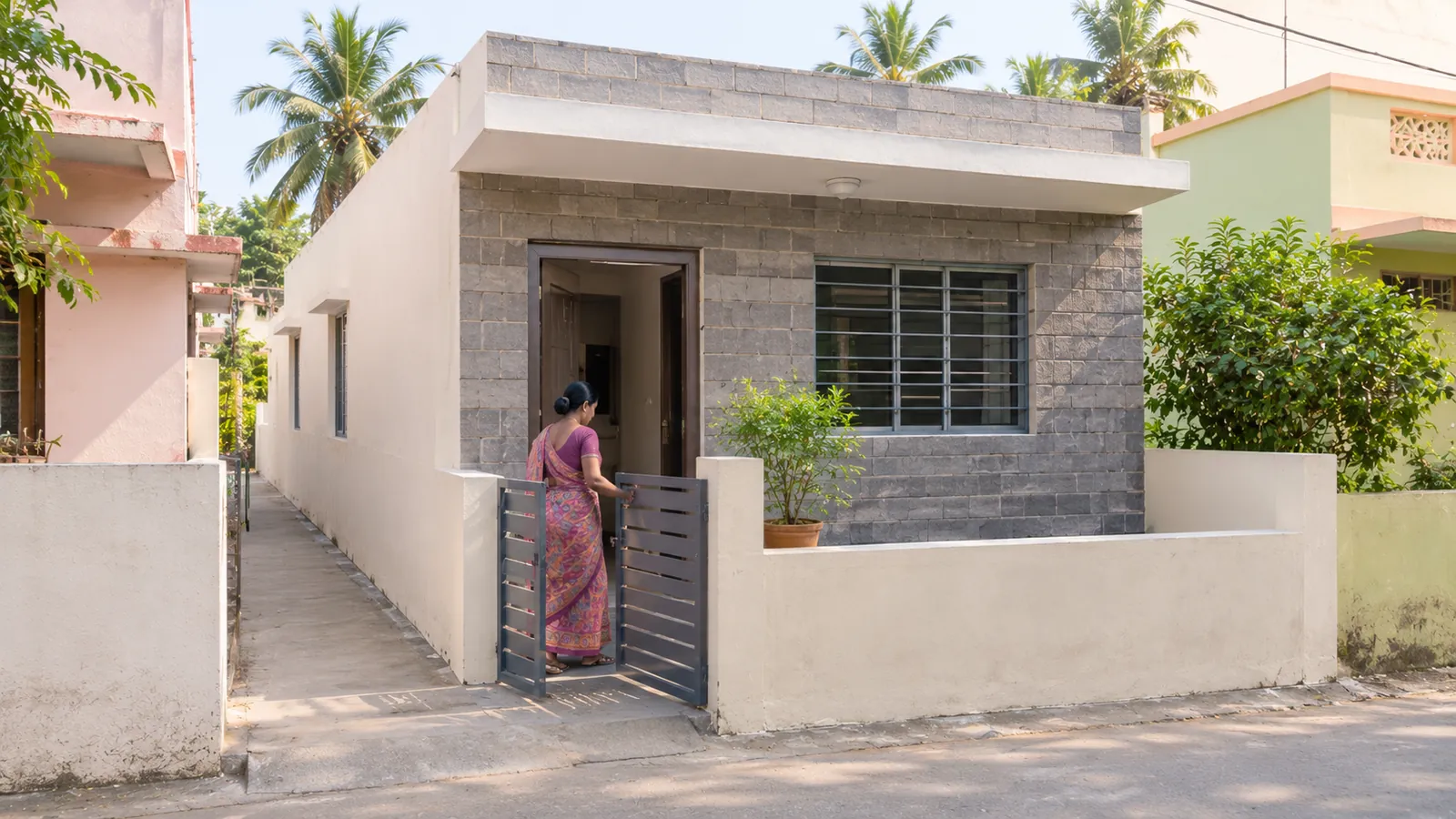
- Exposed brickwork skips the plaster and paint on chosen walls and gives a modern look. It needs good, uniform bricks, neat joints and a clear water-repellent coating on outside walls to stop seepage.
- Skip the false ceiling. In a small house it lowers the room height and adds tens of thousands of rupees. A neatly finished concrete ceiling is enough.
What the ₹6 lakh does not include
Like a vehicle's on-road price, the building cost is only part of the total:
- The land: you must already own the plot or budget for it separately.
- Approval and permit fees.
- Electricity, water and drainage connections.
- Local factors: labour rates in your area, transport of materials and soil conditions can all change the cost.
Getting approval in Tamil Nadu
Tamil Nadu offers an online self-certification building permit for small homes on plots up to 2,500 sq ft, which covers a 1 cent plot. You apply on the official portal, onlineppa.tn.gov.in, pay the fees it calculates and download the permit. Limits and fees can change, so check the portal or ask your local body before applying.
Final word
On a 1 cent plot, plan for about 300 sq ft on the ground floor after setbacks. Remove corridors, open the hall into the kitchen, put the kitchen and bathroom back to back, and consider load-bearing walls with fly ash bricks to save money. Budget separately for land, approvals and connections, and if you may build upward later, design for it from day one.
The plot diagram and costs are examples. Setback rules, permit limits and prices vary by location and change over time; consult a licensed engineer and your local body before building.
Frequently asked questions
How many square feet is 1 cent?
1 cent is 435.6 sq ft, one hundredth of an acre. A common shape is about 20 ft by 22 ft.
How much can I build on a 1 cent plot?
After the road-side and side setbacks, the ground-floor built-up area is usually about 250 to 350 sq ft, depending on your road width and local rules. You can add a first floor to gain more space if the structure is designed for it.
Can I build a house on 1 cent for ₹6 lakh?
For a single-storey home of about 300 sq ft in a town or village, around ₹6 lakh is realistic with careful planning. It does not include the land, approval fees or service connections, and costs vary by city, labour rates and soil.
Is a load-bearing house safe?
Yes, for small one- or two-storey houses designed by an engineer. Load-bearing walls carry the roof without concrete columns, which saves steel and cement. But you can't easily add floors later unless the foundation and walls are designed for them from the start.
Are fly ash bricks better than red bricks?
Fly ash bricks are uniform in size, stronger and absorb less water, so walls come out straighter and need less plaster. Buy them from a reliable maker and check that they are well cured.
Do I need approval to build on a 1 cent plot in Tamil Nadu?
Yes. Tamil Nadu offers an online self-certification permit for small homes on plots up to 2,500 sq ft, through onlineppa.tn.gov.in. Check the current limits and fees on the portal or with your local body.