Starting a Temporary Cracker Shop: Investment, Profit Math, Licence and the Rain Risk
A temporary cracker shop runs for about ten days a year, and almost everything depends on how much of your stock sells before Deepavali night. Sell most of it and a small shop can earn a good seasonal income; get caught by rain and you carry unsold stock and a loan. Here is a worked example you can adapt to your own shop.
- 100% of stock sold₹1,84,000
- 90% sold₹1,15,600
- 80% sold₹47,200
- 75% sold₹13,000
In this guide
Quick answer
- Budget: a small shop can start with about ₹5 lakh, of which roughly three-quarters is stock.
- Sell-through decides profit: in our example, selling 90% of stock earns about ₹1.2 lakh; selling 75% barely breaks even; below about 73% is a loss.
- The last days before Deepavali bring most sales. Rain then is the biggest risk.
- Unsold stock is the hidden cost: agree a return arrangement with your wholesaler before you buy.
- Licence and safety are non-negotiable: Form LE-5 through e-Sevai before the district deadline, and strict fire precautions.
Every year, thousands of temporary cracker shops open across Tamil Nadu in the days before Deepavali, many run by people who do something else the rest of the year. It's a short, high-stakes business. You commit most of your money to stock upfront, and you find out on Deepavali night whether the season paid off.
A sample ₹5 lakh budget
| Item | Amount | Notes |
|---|---|---|
| Stock (including GST paid to wholesaler) | ₹3,80,000 | Gift boxes, sparklers, flower pots, rockets, loose items |
| Rent, shed and lighting | ₹55,000 | Varies widely by town and spot |
| Transport, licence, safety kit, helpers | ₹40,000 | Lorry, LE-5 fee, extinguishers, sand buckets, two helpers |
| Interest on borrowed money | ₹25,000 | If part of the money is borrowed for the season |
| Total | ₹5,00,000 |
Adjust each line to your own town. Rent near a busy junction can cost far more than in a quieter street, but it may also sell much more.
Markup and sell-through: the two numbers that matter
Cracker boxes carry printed prices far above wholesale. Shops price their stock to recover costs and margin from the season. In our example we assume a markup of 1.8 times: ₹3.8 lakh of stock would bring in about ₹6.84 lakh if every item sold. Your own markup may be higher or lower depending on competition.
The other number is sell-through, the share of stock you actually sell. The chart above shows how profit changes:
- 100% sold: about ₹1.84 lakh profit.
- 90% sold: about ₹1.16 lakh.
- 80% sold: about ₹47,000.
- 75% sold: about ₹13,000, close to break-even.
- 60% sold: a loss of about ₹90,000, with ₹1.5 lakh of stock (at cost) left over.
The lesson: buying too much stock is the most common way to lose money. A shop that buys a little less and sells out often earns more than one that overstocks.
When the sales come
- First few days: slow, mostly enquiries and early buyers.
- Middle days: sales pick up as salaries and bonuses arrive.
- Last two or three days before Deepavali: the rush. Most of the season's sales happen here.
- Deepavali night: final sales, and the moment you see how much stock is left.
That's why weather is the biggest risk. Heavy rain in the final days can cut sales sharply, and there's no second chance.
Pricing that brings customers back
- Gift boxes are convenient and popular as presents, and usually carry the best margin.
- Loose crackers are where customers compare and bargain.
- Customers now check prices online and with Sivakasi direct sellers. Fair, consistent pricing and honest quantities bring the same families back every year, and a shop that returns to the same spot each season benefits most from that trust.
What happens to unsold stock
Leftover crackers can't simply be kept at home or in the shop after the licence period; storage needs licensed premises. Before you buy:
- Ask your wholesaler whether they will take back unsold stock, and at what discount.
- Buy in two rounds if your supplier allows: a first lot, then a top-up based on how the early days go.
- Avoid slow-moving items in your first year. Stick to products you know sell.
Licence: apply early
The temporary shop licence is Form LE-5 under the Explosives Rules, 2008, granted by the district authorities. In Tamil Nadu in 2026:
- Apply online through an authorised e-Sevai centre. Physical applications are not accepted in many districts.
- Watch the district deadline, around mid-October in most districts, and earlier in some.
- Documents: Aadhaar, PAN and ration card, photo, property tax receipt or patta, the owner's NOC if rented, a site plan of the shop and its surroundings, and the fee receipt.
- Fee: a few hundred rupees through the e-Treasury portal (₹700 in many districts; check yours).
- Validity: a short period around the festival. Follow the dates printed on your licence.
Safety rules you must follow
Cracker shops have caused deadly fires. The rules exist because a single spark can destroy a whole row of shops.
- Non-flammable shed, closed and secured, at least 3 metres from the next shed, and shops shouldn't face each other.
- Away from schools, hospitals and places of worship, petrol pumps and high-voltage lines.
- No naked lights, oil lamps or loose hanging wires. Fixed electrical fittings with a master switch.
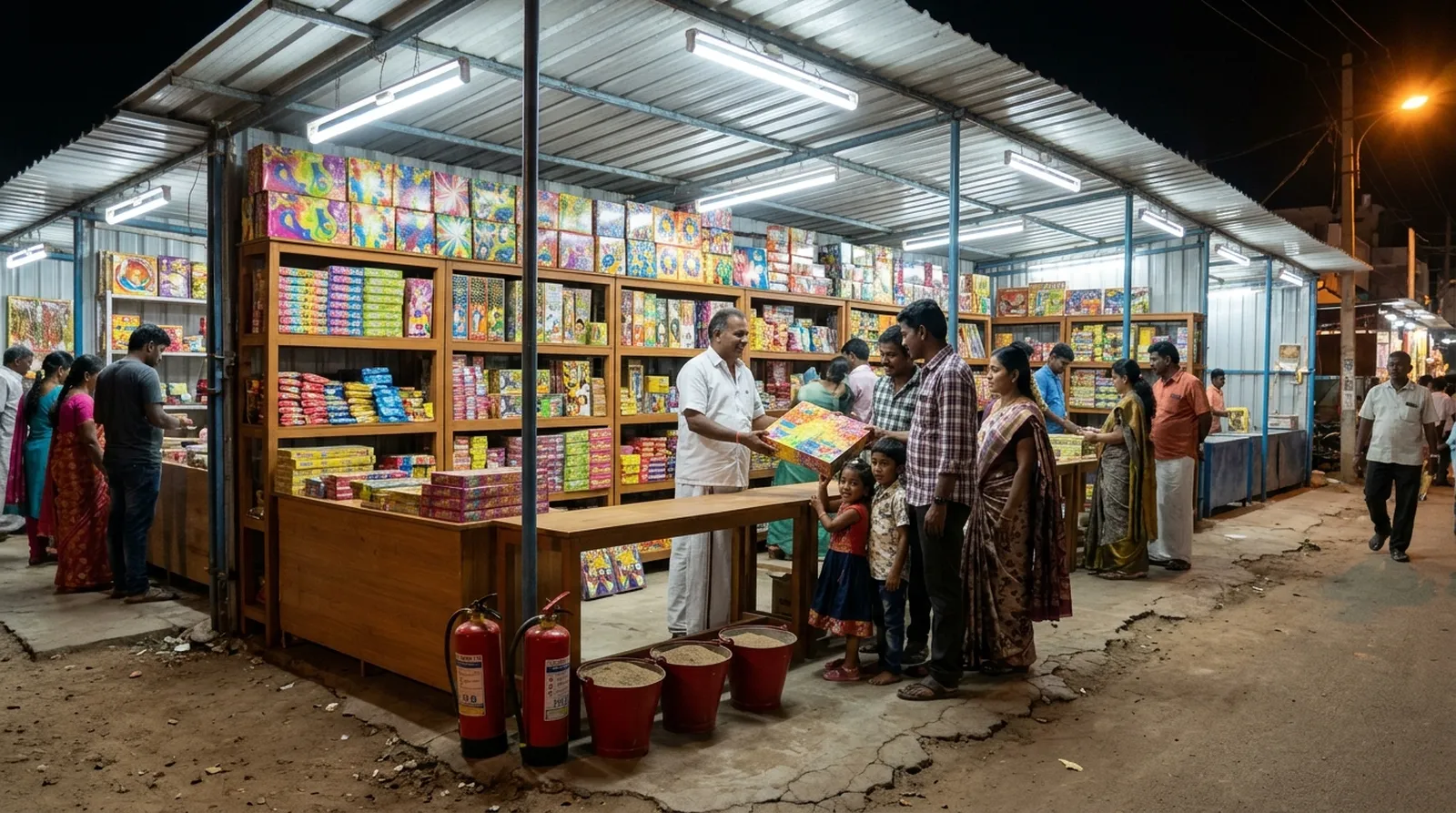
- At least two fire extinguishers, plus buckets of dry sand and water at the shop.
- No smoking, and no lighting crackers anywhere near the shops.
- Warning board reading "Explosive and Dangerous Goods" in Tamil.
- Stock within the licensed quantity. Don't store extra boxes behind the shop or at home.
GST and accounts
Fireworks attract 18% GST, which is already included in what you pay the wholesaler. A small seasonal shop like our example, with total yearly turnover well below the registration limit, usually doesn't need to register; the GST paid on stock is simply part of your cost. If your turnover, including any other business you run, crosses the limit, you must register, charge GST and can then set off the GST paid on stock. Ask a tax consultant before the season, and keep every purchase bill.
Before you start
- Location: a busy spot with parking, permitted by the licence rules.
- Licence: e-Sevai application well before the district deadline.
- Stock: reliable Sivakasi suppliers with proper bills; buy less rather than more in your first year.
- Return option: agreed with your wholesaler in advance.
- Cash plan: assume 20–30% of stock may not sell, and check you can survive that.
- Safety kit and trained helpers in place before the first sale.
- Weather backup: a covered, well-lit display so customers still come in light rain.
Final word
A temporary cracker shop can earn a good seasonal income in about ten days, but only if most of the stock sells. Profit is decided by two numbers you control, how much you buy and how you price it, and one you don't, the weather in the final days. Start smaller than you think, agree returns with your supplier, keep your licence and safety in order, and price fairly so customers come back next year.
All figures are an illustrative example with stated assumptions, not data from any particular shop. Prices, markups, licence fees, deadlines and safety rules vary by district and change from year to year. Check the current rules with your district administration and fire service, and take a tax consultant's advice on GST.
How we made this guide
- Facts checked against 3 sources, listed at the end of the guide.
- Worked examples and calculations are our own, with the assumptions stated in the guide.
- Last updated November 2, 2026. We revise guides when rules and prices change.
Frequently asked questions
How much investment is needed to start a temporary cracker shop?
Small shops start with a few lakh rupees. In our example, ₹5 lakh covers ₹3.8 lakh of stock, about ₹95,000 for rent, shed, transport, licence, safety equipment, helpers and lighting, and about ₹25,000 interest on borrowed money. Larger shops in busy locations invest much more.
How much profit can a small cracker shop make?
It depends mostly on how much stock sells. In our example, with stock marked up 1.8 times, selling everything earns about ₹1.8 lakh, 90% about ₹1.2 lakh and 80% about ₹47,000. Below about 73% the shop makes a loss.
How do I get a temporary cracker shop licence in Tamil Nadu?
The temporary licence is Form LE-5 under the Explosives Rules, 2008. In Tamil Nadu, applications go online through an authorised e-Sevai centre before the district deadline, usually in mid-October, with ID proof, property documents or the owner's NOC, a site plan and the fee receipt. Check your district's dates early.
Do I need GST registration for a cracker shop?
Fireworks carry 18% GST, which is already included in the price you pay the wholesaler. A small seasonal shop whose total yearly turnover is below the registration limit usually doesn't have to register. Larger shops, or owners with other businesses that push the total above the limit, must register and charge GST. Confirm with a tax consultant.
What happens to unsold crackers after Deepavali?
They can't be stored at home or in an unlicensed place. Ask your wholesaler before buying whether they will take back unsold stock and at what discount. Otherwise the money stays locked up until next season, and storage needs proper licensed premises.
What safety rules apply to a temporary cracker shop?
The shed must be of non-flammable material, kept at least 3 metres from other sheds and away from schools, hospitals and places of worship, with no naked lights, at least two fire extinguishers, sand and water buckets, no smoking, and an 'Explosive and Dangerous Goods' warning board. Follow the conditions printed on your licence.