Terrace Leakage: Tiles vs Seamless PU Coating, Which Waterproofing Works?
Most terrace leaks start at a joint. Tiles always have joints; a seamless polyurethane (PU) coating doesn't. But PU only works if the surface is prepared properly, and it's not the only good option. Here is how to choose and what to insist on.
In this guide
Quick answer
- Tiles leak at the joints. Daily heating and cooling cracks them, and the water travels under the tiles before it shows up inside.
- A seamless PU coating has no joints, stretches over small cracks and reflects heat. It typically costs about ₹60–₹250 per sq ft and lasts 10–15 years.
- Preparation decides success, whatever you choose: slope to the drains, cracks repaired, a dry clean surface, primer, the right thickness, and a water test before use.
A leaking terrace is one of the most frustrating house problems, because the stain on your ceiling is often nowhere near where the water got in. Understanding why leaks happen makes the choice of fix much easier.
Why tiled terraces leak
Terracotta tiles, "cool roof" tiles and ceramic tiles all have one thing in common: joints.
- Expansion and contraction: a terrace heats up in the afternoon sun and cools down at night and in the rain. This daily movement slowly cracks the joint filling.
- Hidden water paths: water that gets in through a cracked joint spreads under the tiles along the slab. It may come out in the bedroom ceiling even though it entered above the living room, so finding the leak can mean breaking up a large area.
- Dead weight and debonding: tiles and their mortar bed add weight to the roof, and large tiles can lose their grip and pop up after years of heat cycles.
- Algae and moss: rough or porous tiles catch moss in the monsoon and become slippery.
To be fair to tiles: a tile or brickbat layer also protects whatever waterproofing is beneath it from sun and foot traffic, and adds some insulation. The problem is relying on tiles alone to keep water out.
What a PU coating does differently
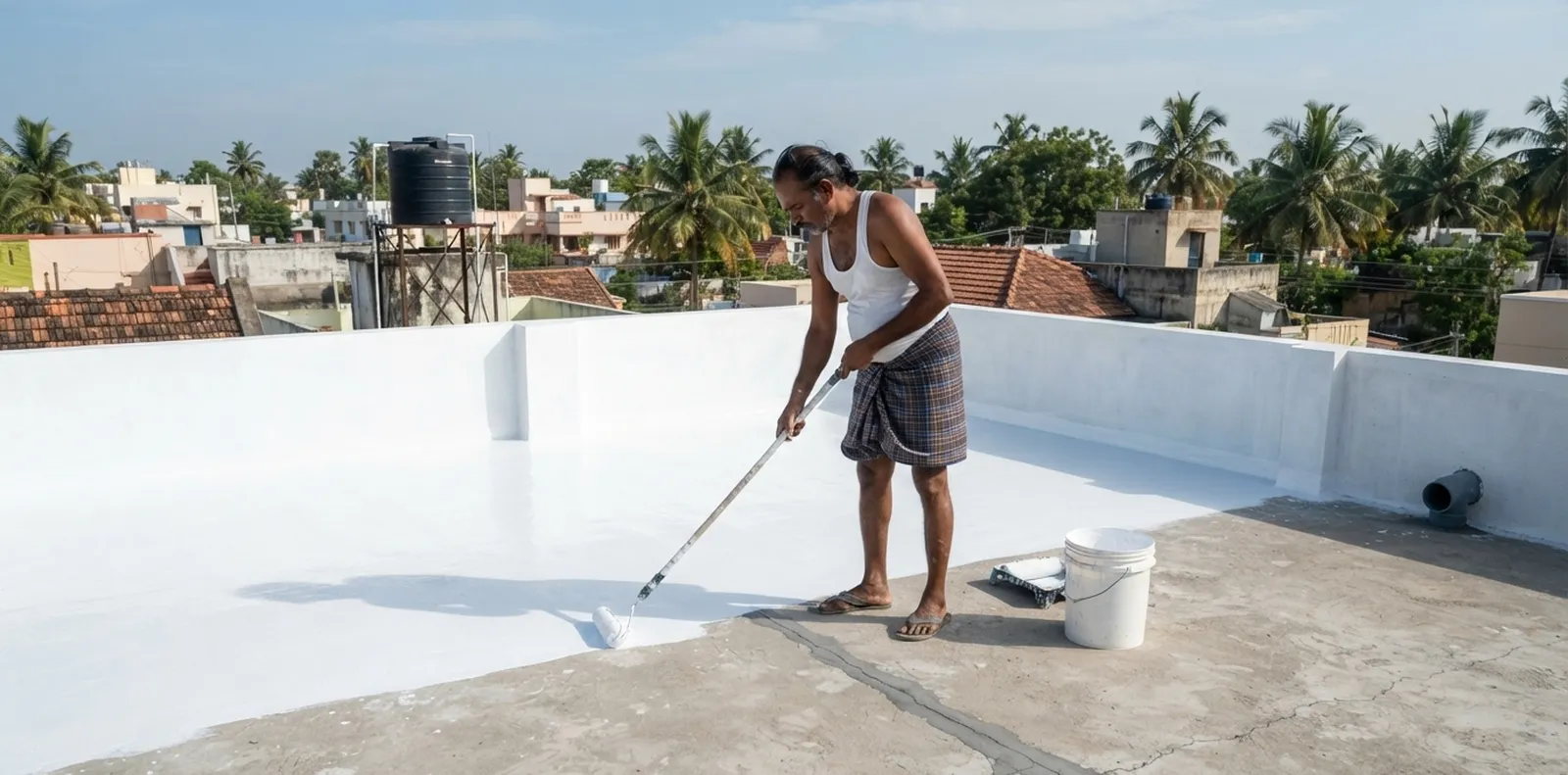
A polyurethane (PU) roof coating is applied as a liquid and cures into a continuous, rubber-like skin.
- No joints: it runs unbroken across the slab and up the parapet walls and around pipes, the places where most leaks start.
- Stretch: good PU coatings are elastic and can stretch to bridge fine cracks that open and close in the slab beneath.
- Heat reflection: white and light-coloured roof coatings with a high Solar Reflectance Index (SRI) reflect much of the sun's heat, so the rooms below stay cooler.
- Easy repair: if a patch is damaged, for example when fixing a solar panel stand, that area can be cleaned and recoated without breaking up the whole terrace.
PU coating: the limits to know
PU coatings are a strong option, but not magic:
- Sunlight: some PU membranes need a UV-resistant top coat when left exposed. Ask whether the product you're buying is designed to be left exposed to sun on its own.
- Wear: heavy foot traffic, dragging furniture or water tanks can wear it down. Protect high-traffic areas.
- It can't fix bad preparation: if water ponds because the terrace has no slope, or the slab is damp when coated, the coating can blister and fail.
- Recoating: plan for inspection every year and a fresh coat on worn areas over time.
Cost and lifespan compared
| Method | Approx. cost per sq ft | Typical life |
|---|---|---|
| Cementitious coating | ₹35–₹90 | 4–6 years |
| Bituminous membrane | ₹80–₹180 | 6–10 years (needs protection from sun) |
| Liquid membrane (acrylic etc.) | ₹90–₹220 | 8–12 years |
| PU coating | ₹60–₹250 | 10–15 years |
Prices vary widely with the product, coat thickness, preparation work and city. Ask every contractor to quote the same product, number of coats and thickness, so you compare like with like.
Doing it right: the steps that matter
Whatever system you choose, these steps decide whether it works:
- Clean the terrace of dust, moss, loose plaster and old peeling paint.
- Repair cracks and holes, and fill any honeycombed concrete.
- Check the slope. Water must flow to the drains; a slope of at least about 1 in 100 is needed. No coating can stop leaks where water stands for days.
- Make sure the surface is dry. Coating a damp slab traps moisture and causes blisters.
- Apply the primer recommended for the product.
- Apply the coats at the thickness the manufacturer specifies, usually two coats in opposite directions.
- Turn it up the walls: take the coating about 150–200 mm up the parapet walls and seal around every pipe and drain.
- Water test: once cured, flood the terrace with a few centimetres of water for 48–72 hours and check the ceilings below before handing over.
Questions to ask the contractor
- Which product and how many coats? Get the product name and thickness in writing.
- Is it suitable for exposed sunlight, or does it need a top coat?
- What surface preparation is included? Crack repair, cleaning, primer.
- Will you do a water test before final payment?
- What warranty do you give, and what does it cover?
Final word
Tiled terraces leak mainly through their joints, and the leak often shows up far from the cause. A seamless PU coating removes the joints, bridges small cracks and keeps the roof cooler, and usually lasts 10 to 15 years. But the real key is preparation: a proper slope, a repaired, dry surface, the right thickness and a water test. Get those right, and choose the product on its datasheet, not its advertising.
Costs and lifespans are approximate and depend on product, preparation and climate. Follow the manufacturer's instructions for the product you choose.
Frequently asked questions
Why do terrace tiles leak?
Tiles need joints, and the sun and rain make the roof expand and contract every day. Over time the joints crack, water seeps under the tiles and travels along the slab, so the leak often appears inside a different room from where the water got in.
What is PU coating for terraces?
It is a liquid polyurethane membrane rolled or brushed onto the terrace. It cures into a seamless, rubber-like layer with no joints that can stretch to bridge small cracks and reflect much of the sun's heat.
How much does PU terrace waterproofing cost per sq ft?
Roughly ₹60 to ₹250 per sq ft, depending on the product, number of coats, surface preparation and whether labour is included. Always compare quotes for the same product and thickness.
How long does PU waterproofing last?
Typically 10 to 15 years when the surface is properly prepared and the coating is protected from heavy wear. Inspect it every year and recoat worn patches early.
Can I apply PU coating over old tiles?
Sometimes, if the tiles are firmly bonded, clean and the joints are repaired, and the product is approved for tiled surfaces. Loose or hollow tiles must be removed first, or the coating will fail with them.
Does PU coating reduce heat in the house?
White or light-coloured PU roof coatings with a high Solar Reflectance Index (SRI) reflect much of the sunlight, so the roof surface and the rooms below stay cooler than with a dark, bare slab.