How to Find Your First Export Buyer: Realistic Ways That Work, and the Traps to Avoid
Ask anyone who has tried exporting and they will tell you the same thing: registrations take three weeks, the first buyer can take a year. Importers already have suppliers they trust, and switching to a newcomer is a risk they do not need to take. This guide is about giving them a reason to, through channels that actually work for a small exporter from Tamil Nadu.
- Importers contacted200 companies
- Replied40 companies
- Asked for samples12 companies
- Trial orders3 companies
- Repeat buyer1 companies
In this guide
Quick answer
- Why it's hard: importers already trust their suppliers. You need a reason for them to switch.
- Best channels for small exporters: your export promotion council's buyer-seller meets and trade fairs (government now shares 60–80% of costs), Trade Connect and Indian missions, supplying an existing exporter, diaspora markets, and targeted outreach using trade data.
- Expect a funnel: in our example, 200 importers contacted → 1 repeat buyer, over months.
- Win with samples and small trial orders, then deliver exactly what the sample promised.
- Verify every buyer, and never pay "registration" or "certification" fees to people promising orders.
The first export buyer is the hardest part of exporting, and most guides gloss over it. The honest picture: a serious importer in London, Dubai or Singapore already has suppliers who have delivered the right quality on time for years. Changing to a new supplier from India is a risk for them. Your job is not to "find buyers" in general; it is to find the few buyers for whom you are a better bet than what they already have, and make it easy for them to test you.
What importers actually look for
Before looking for buyers, be ready for what they will check:
- Consistent quality: the bulk order must match the sample, every time.
- Reliable delivery: shipping on the promised date matters as much as price.
- Quick, clear replies: buyers drop suppliers who take days to answer.
- Compliance: the certificates, labels and test reports their market requires.
- A reason to switch: a niche product, a smaller minimum order, better finishing, a faster turnaround, or a genuinely better price.
If you cannot yet offer at least one clear advantage, work on that first; more outreach will not fix it.
Step 1: choose the product and two or three markets
Do not try to sell to "the world". Pick one product line and two or three countries where:
- the product is already imported in good volumes,
- India's tariff position is competitive (for example under a free trade agreement),
- you can meet the standards and labels.
The government's Trade Connect e-platform offers product and country guides, a trade agreement and tariff explorer, and an "Ask an Expert" service, and connects exporters with Indian missions abroad and export promotion council officials. Your council's market reports are another free starting point.
Step 2: use the channels that work for small exporters
1. Your export promotion council
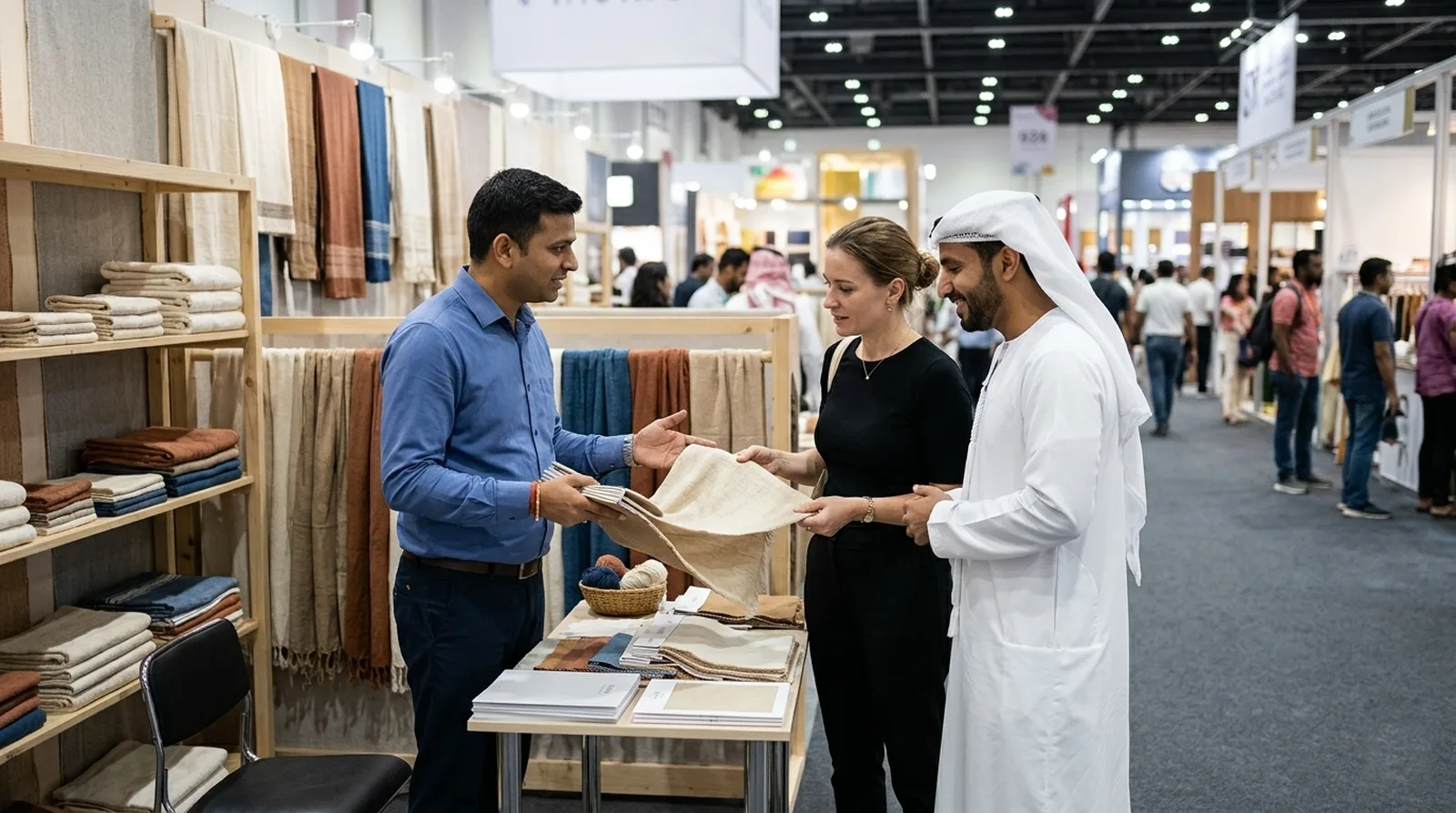
The council for your product (APEDA, AEPC, EPCH, EEPC and others) runs buyer-seller meets, India pavilions at international trade fairs, and reverse buyer-seller meets where foreign buyers visit India. Under the government's market access support launched in December 2025, the government bears 60% of the cost of supported events (up to 80% in priority sectors), and 35% of the support for buyer-seller meets and trade delegations is reserved for MSMEs. For a small exporter, a subsidised stall at the right fair is often the single best place to meet ten serious buyers in three days.
2. Trade Connect and Indian missions
Indian embassies and high commissions have commercial wings that receive enquiries from local importers. Through Trade Connect, you can reach mission officials and list your products under its "Source from India" feature. Missions cannot sell for you, but a good product profile in the right place gets you in front of buyers who are already asking.
3. Supply an established exporter first
The most underrated route: become a supplier to an exporter who already has buyers. You learn export packing, inspection and timelines without carrying payment or buyer risk, and you build a record you can show your own buyers later. Many Tirupur and Karur units started this way.
4. Diaspora markets for traditional products
Traditional Tamil Nadu products, from snacks and spice mixes to handloom and brassware, have natural buyers in Indian grocery and lifestyle stores in Singapore, Malaysia, the Gulf, the UK and North America. These importers know the product, and smaller trial orders are common.
5. Targeted outreach using trade data
Paid import data from shipping records can show which companies abroad import your product and from where. Use it to build a short, targeted list of 100–200 importers, research each one, and write a short, specific email: who you are, what you make, what makes you different, and an offer of samples. Follow up politely two or three times. This is slow, but it is how many small exporters find their first steady buyer.
6. B2B portals: with caution
International and Indian B2B portals generate many enquiries, but a large share are price-shoppers, data-collectors or outright fraud. Treat portal enquiries as leads to verify, not as orders.
A worked example: the outreach funnel
Our own illustrative numbers for a small Madurai exporter of handloom cotton towels, working on targeted outreach over three months:
| Stage | Count |
|---|---|
| Importers researched and contacted | 200 |
| Replied with interest | 40 |
| Asked for samples | 12 |
| Placed a small trial order | 3 |
| Became a repeat buyer | 1 |
The chart above shows the same funnel. Two lessons: most outreach gets no reply, which is normal, not failure; and samples cost money. Twelve sample parcels by international courier can cost around ₹40,000–50,000, so send samples only to buyers you have checked, and ask serious buyers to pay courier costs or adjust them against the first order.
One repeat buyer can be worth more than many one-off orders. Deliver the trial order exactly as the sample promised, communicate at every step, and ask for feedback.
How to verify a buyer
- Check the company's registration in its own country and its physical address.
- Prefer a company email domain; be wary of free email addresses for large orders.
- Look for a trading history: website age, references, trade fair participation.
- Ask ECGC (Export Credit Guarantee Corporation) for a credit limit on the buyer before offering credit; ECGC assesses the buyer's creditworthiness.
- Start with advance payment or a letter of credit until you have a track record together.
Red flags: fake buyers and "export help" scams
In June 2026, Delhi police busted a fake call centre that posed as an export consultancy and as foreign buyers. Victims paid a ₹5,000 "registration" amount, then about ₹19,780 for "export service packages" and ₹41,300 for supposed certifications, after being shown fabricated buyer messages from international WhatsApp numbers; then the callers vanished. Police linked 19 complaints totalling over ₹10.5 lakh.
Warning signs:
- Anyone who asks you to pay fees, "certification charges" or "buyer membership" before an order.
- A "buyer" who wants samples free and urgently, with no company details.
- Pressure to decide fast, or payment requested to a personal account.
- Promises of guaranteed orders in exchange for a course or database fee.
Genuine buyers pay you; they do not charge you to become their supplier.
Final word
Finding the first export buyer is a numbers game played with patience: the right product, two or three focused markets, the subsidised channels your export promotion council offers, a short list of well-researched importers, and samples that match the bulk. Expect months, not weeks. Protect yourself by verifying every buyer and never paying anyone who promises orders. Once the first buyer trusts you, the second one comes much more easily.
This guide is general information, not legal, financial or business advice. Government schemes, cost-sharing rates and platforms change, and the outreach funnel is our own illustration. Check current support with your export promotion council and use your bank and ECGC for payment protection.
How we made this guide
- Facts checked against 4 sources, listed at the end of the guide.
- Worked examples and calculations are our own, with the assumptions stated in the guide.
- Last updated November 3, 2026. We revise guides when rules and prices change.
Frequently asked questions
How do new exporters find buyers?
The channels that work best for small exporters are the buyer-seller meets and trade fairs organised by their export promotion council, the government's Trade Connect platform and Indian missions abroad, supplying an established exporter first, diaspora markets for traditional products, and targeted outreach to importers identified from trade data, followed up with samples and small trial orders.
Why is it so hard to get the first export order?
Importers already have suppliers they trust on quality, delivery and payment. A new supplier is a risk to them, so they test with samples and small orders, and switch only when the newcomer offers a clear advantage such as better consistency, a niche product, faster response, flexibility on small quantities or a better price.
Does the government help small exporters attend trade fairs?
Yes. Under the market access support launched in December 2025, the government shares 60% of the cost of supported buyer-seller meets, trade fairs and trade delegations, up to 80% in priority areas, with 35% of support for buyer-seller meets and delegations reserved for MSMEs. Participation is usually through your export promotion council.
Are B2B portals and buyer databases worth paying for?
Use them with caution. B2B portals produce many enquiries, but a large share are price-shoppers or fake. Paid importer data can help you build a targeted list, but no database or membership guarantees orders. Never pay large fees to anyone promising guaranteed buyers.
How can I check whether a foreign buyer is genuine?
Check the company's registration in its own country, its website and business address, and trade references; ask for a company email rather than a free email address; seek an export credit insurance limit on the buyer from ECGC; and start with advance payment or a letter of credit until a track record exists. Any 'buyer' who asks you to pay fees before ordering is a red flag.
Should I start by supplying another exporter?
It is often the most practical first step. Supplying an established exporter teaches you export quality standards, packing and timelines without the payment and buyer risk, and gives you a track record to show your own buyers later.